
Zero: Chapter 5 - The Graveyard Shift
Zero has a single graveyard where its residents are buried. We called it Zero G. Its full name is St. Anne's Home for the Internment of the Mentally Impaired.

Zero, a mysterious town in the American Midwest, is eulogized here in this semi-biographical collection of Modern Folklore stories. Although storylines overlap occasionally, each was written to be read independently, so feel free to jump in anywhere. Click on Start Here to view the Chapter List.
In the town where I was born, no buildings stood over two stories high. This was a requirement put into place by city ordinance. No county commission was ever established, nor was the State assembly consulted. Zero, my town, was for all intents and purposes, invisible to outside authority.
Outsiders never paid much attention to our little town. There was only the one road in and the one road out, and they were the same road. No one knew its actual name. We called in Hwy One. It was the only paved road in all of Zero. Our town didn’t appear on any maps. Neither did the road. Most people who came to Zero arrived by accident.
The ordinance that established how tall a building could be, was written in such a way that it could not be revised by a later council. They chiseled it in bedrock. Literally. Not that anyone cared. Land was cheap. So was bedrock. The ordinance didn’t actually specify how many stories a building could be, it specified the maximum height allowed when measured from the same piece of bedrock on which the ordinance was chiseled. This height in most areas of town came to just over two-stories.
The strange and oddly specific way in which the ordinance was written was not lost on the townspeople of Zero. Unfortunately, the originators went out of their way to expunge all minutes, diaries and other records relating to the town leading up to that point in time. That point in time being exactly 8:38 P.M. on June 17, 1838. We don’t even know the names of the originators. The most popular theory for the ordinance revolves around the town graveyard and the graveyard shift.
Zero has a single graveyard where its residents are buried. We called it Zero G. Its full name is St. Anne’s Home for the Internment of the Mentally Impaired. A name unwieldy by any measure. It makes for a splendid ironwork arch, however. It is assumed that in the past there was another graveyard for the mentally stable, but if so, it has never been located.
No stones in Zero G list any dates prior to June 17, 1838. Some stones, those for its earliest residents, are completely blank, not even their names appear. As you might imagine, there are questions concerning those stones. Were they always blank, or were they replaced? Did someone modify them at a later date, and if so when were they chiseled clean and by whom? It is an eerie feeling to walk through a graveyard where many of stones are naked slabs.
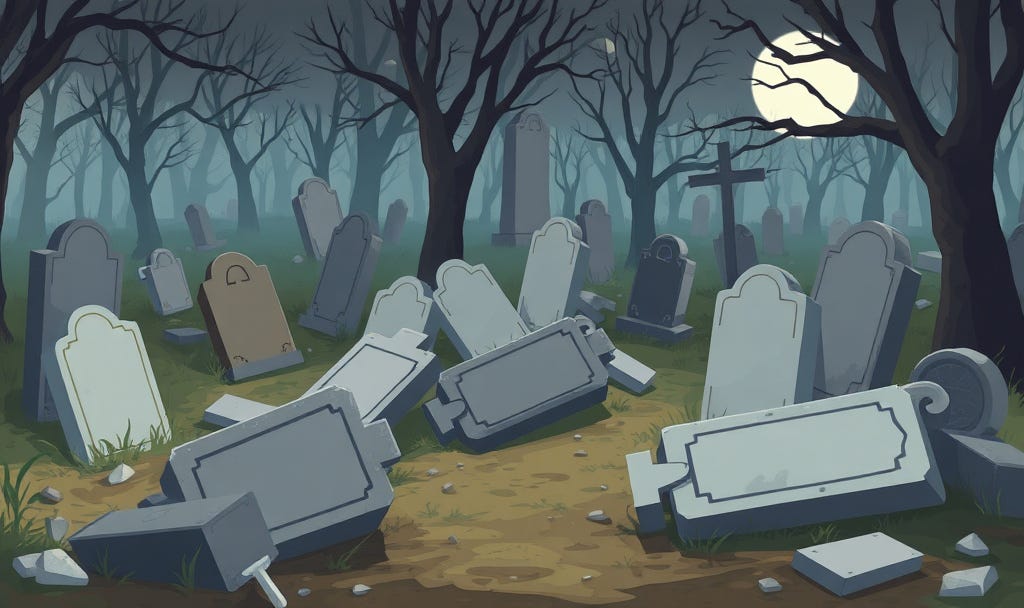
In the 1870s, one of those graves was exhumed to ensure that a body was actually buried there. It was. It was a young girl. She had been brutally murdered. She was also holding a red rose. A freshly cut red rose. Afterwards the town was subjected to a heavy wind for several days during which every tombstone in Zero G was blown over. They tried to stand them back up, but they just fell over again within a few days. When new graves are dug and new stones added to the officially sanctioned cemetery, they also fall over shortly after being erected. Sometimes while the family is still at the gravesite. It can be very disheartening for those present. No amount of engineering has, as of yet, been able to keep those stones standing. It appears that the ground, at least near the surface, moves sideways a short distance and then back. Rebar support posts are sheered completely through. The residents refer to this as the graveyard shift. For this reason, many of the townspeople find other places to bury their loved ones. Often without a tombstone.
Many families have maps showing where the graves of their loved ones are located. They pass these maps down to their children, and they to theirs. More than once, someone was digging in a field to install a fence or a well and came across a boneyard. Finding which family they belong to is usually resolved at an emergency town meeting. The affected family, if it can be determined who they are, are given the opportunity to relocate the exposed remains under the cover of darkness. This cover allows the new location to remain a secret. Family remains sometimes become separated from their relatives and are in this way spread out along the landscape. For some families, using their graveyard maps to locate their loved ones is akin to treasure hunting.
When my father passed away a few years back, I returned to Zero to attend the funeral. My mother decided it was best to have him cremated. At the funeral, his urn fell over.
Twice.
His urn now sits on my mother’s fireplace mantel — on its side.
Zero G, the only graveyard in the small town of Zero, is also the point of highest elevation. There are no buildings anywhere in the town that rise above it.